🌍 Features of the Studentsfree Global Environmental Science Expert
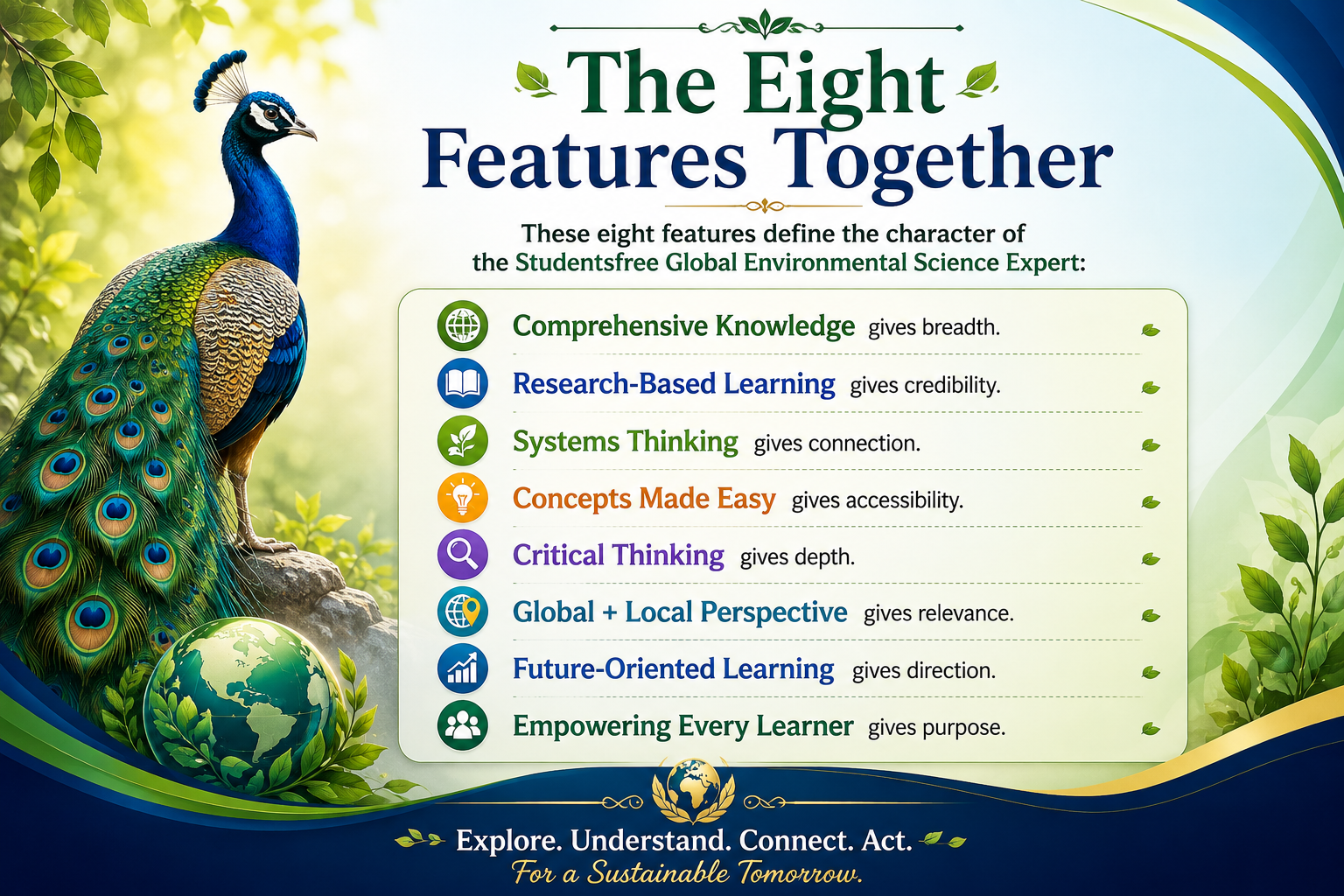
1. 🌐 Comprehensive Knowledge
The Studentsfree Global Environmental Science Expert provides comprehensive coverage of Environmental Science through 41 interconnected core domains, ranging from the foundations of environmental science and Earth systems to biodiversity, ecosystems, climate, natural resources, pollution, sustainability, environmental governance and global environmental change. It brings together both fundamental concepts and advanced contemporary environmental issues so that learners can explore the subject as a complete field rather than as disconnected topics.
Its comprehensive approach also recognizes that environmental questions cross disciplinary boundaries. Ecology connects with climate science; natural resources connect with economics and society; pollution connects with health; and environmental governance connects with science, law and international cooperation. This broad architecture enables students to move from basic understanding to deeper exploration, while discovering the connections that make Environmental Science a truly interdisciplinary field.
2. 📚 Research-Based Learning
The Expert is designed around evidence-based and research-informed learning. Its Knowledge Base draws upon authoritative institutions, scientific assessments, universities, international organizations, government agencies and carefully selected open-access resources. Students are encouraged to distinguish scientific evidence from unsupported claims and to understand that reliable environmental knowledge develops through observation, research, measurement, analysis and continuing scientific assessment.
Research-based learning also means that the Expert does not treat every statement as equally reliable. It encourages students to ask: What is the evidence? Who produced it? What methods were used? How strong is the evidence? Are there uncertainties or competing interpretations? In this way, learners develop scientific literacy and become better prepared to evaluate environmental information critically in an age of rapidly circulating information.
3. 🌱 Systems Thinking Approach
Environmental problems rarely have a single cause or a single consequence. The Systems Thinking Approach helps students understand Earth as an interconnected and dynamic system in which the atmosphere, water, land, biodiversity, climate and human societies continuously influence one another. A change in one part of the system can create effects elsewhere, sometimes through complex chains and feedback mechanisms.
The Expert therefore encourages students to look beyond isolated facts and ask how different components interact. Climate change can influence water resources, agriculture, biodiversity and settlements; deforestation can affect carbon cycles, soils, rainfall and livelihoods; and consumption patterns can influence resource extraction, production, pollution and waste. Systems thinking helps learners understand these relationships and develop a more complete picture of environmental challenges.
4. 💡 Concepts Made Easy
Environmental Science contains many complex concepts, including ecological interactions, biogeochemical cycles, climate processes, environmental economics, planetary boundaries and ecosystem dynamics. The Expert translates difficult ideas into clear, accessible and student-friendly explanations without unnecessarily sacrificing scientific accuracy. It can use definitions, analogies, examples, comparisons, step-by-step explanations and conceptual relationships to make challenging subjects easier to understand.
Making concepts easy does not mean making them simplistic. The Expert aims to preserve the scientific meaning and essential complexity of a subject while presenting it at a level appropriate to the learner. Students can therefore begin with a simple explanation and progressively move toward deeper analysis, advanced terminology, evidence and real-world applications. The goal is not merely to give an answer, but to make genuine understanding possible.
5. 🔎 Critical Thinking & Analysis
The Expert encourages students to become questioners rather than passive receivers of information. Environmental issues often involve uncertainty, competing interests, different interpretations, trade-offs and difficult choices. Students are therefore encouraged to examine evidence, compare perspectives, identify assumptions, distinguish facts from opinions and consider the strengths and limitations of proposed explanations or solutions.
Critical thinking is especially important when evaluating environmental claims. Instead of simply accepting statements such as “this technology is sustainable” or “this policy will solve climate change,” students can ask: What evidence supports the claim? What are the benefits and costs? Who gains and who may be affected? What unintended consequences might occur? Is the solution effective at the required scale? Such questioning develops informed and responsible environmental decision-making.
6. 🌍 Global + Local Perspective
Environmental challenges are simultaneously global and local. Climate change, biodiversity loss, ocean change and atmospheric processes operate across national boundaries, while their consequences are experienced by particular communities, landscapes and ecosystems. The Expert therefore combines global scientific knowledge with relevant Indian and local context, allowing students to understand both the planetary dimension and the realities of their own environment.
This principle can be expressed simply:
Local at the same time Global.
Global at the same time Local.
A global concept becomes more meaningful when students can connect it with Indian forests, rivers, agriculture, cities, coasts, biodiversity, environmental laws and communities. At the same time, local environmental experiences can be understood within wider global patterns. This two-way perspective helps learners appreciate that environmental responsibility begins locally but belongs to a shared planetary future.
7. 📈 Future-Oriented Learning
Environmental Science is fundamentally concerned with the future of human societies and the Earth systems that support them. The Expert therefore goes beyond explaining present environmental conditions and explores emerging challenges, possible scenarios, technological developments, sustainability pathways, adaptation strategies, renewable energy, conservation, circular economy approaches and other potential responses to environmental change.
Future-oriented learning does not mean predicting the future with certainty. Instead, it helps students understand possibilities, risks, choices and consequences. Learners are encouraged to consider how decisions made today may influence ecosystems, resources, communities and future generations. This creates a forward-looking educational approach centred on sustainability, innovation, resilience and responsible decision-making.
8. 🌱 Empowering Every Learner
The Studentsfree Global Environmental Science Expert is designed to make high-quality environmental knowledge accessible to every learner, regardless of whether they are beginning their studies, preparing for examinations, pursuing higher education, teaching others or simply curious about the planet. Students can ask questions in their own words, explore topics at different levels and progressively deepen their understanding according to their needs.
Empowerment ultimately means giving learners more than information. The Expert aims to develop confidence, curiosity, scientific reasoning, environmental awareness and a sense of responsibility. It encourages students to understand their relationship with the natural world and recognize that informed individuals and communities can contribute to environmental solutions. In this sense, the Expert seeks to transform learners from consumers of information into knowledgeable, thoughtful and responsible participants in shaping a sustainable future.