
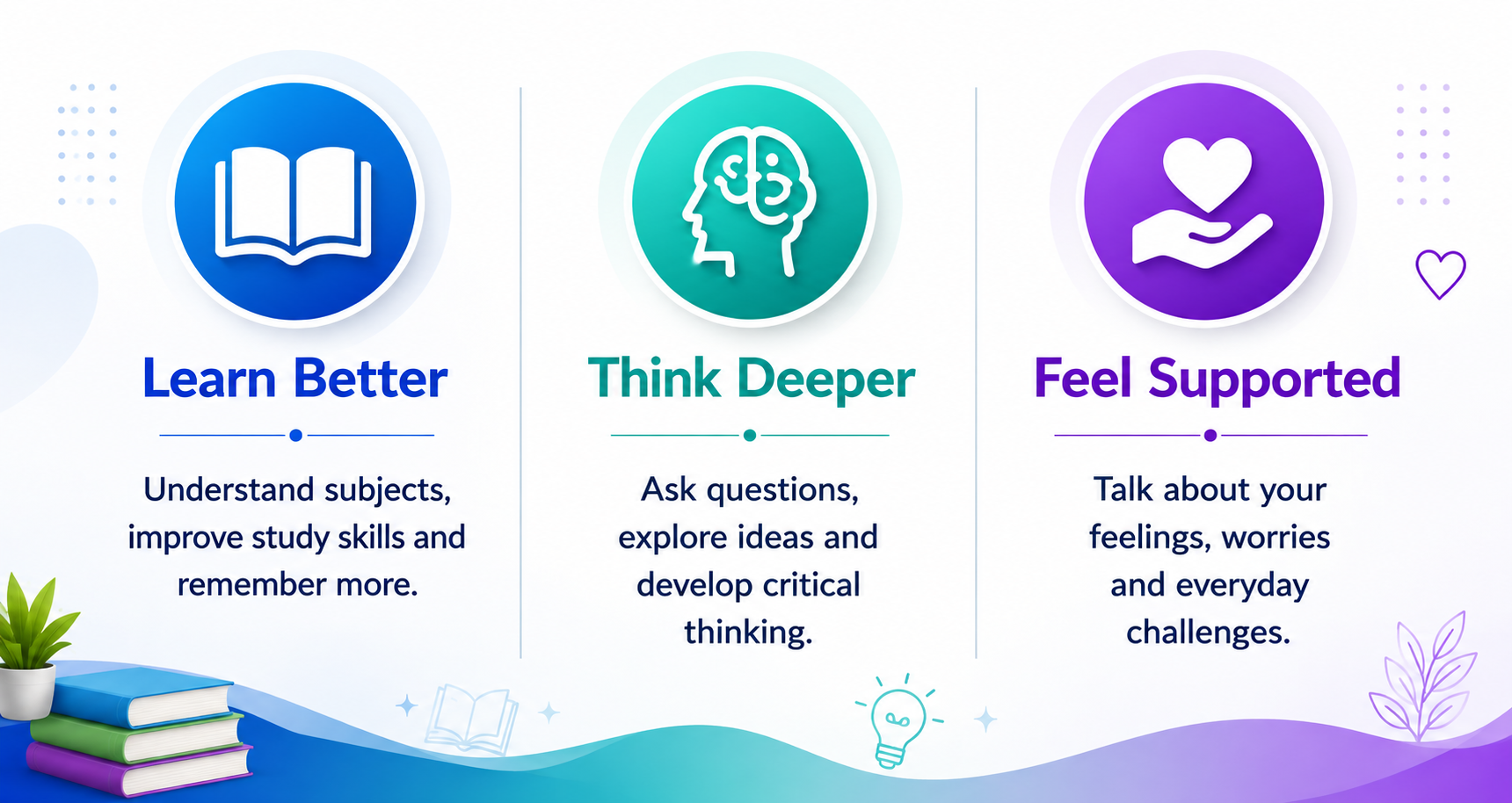
Learn Better. Think Deeper. Feel Supported.
The Three Foundations of Chat with Friend
Students need more than information to succeed. They need to understand what they are learning, develop the ability to think independently, and have a respectful space where they can talk about the everyday challenges of student life.
Chat with Friend brings these three dimensions together.
1. Learn Better
Understand subjects, improve study skills and remember more.
Learning is not simply about reading more pages or spending more hours with a textbook. Effective learning begins with understanding.
Chat with Friend can help students break difficult subjects into manageable ideas, connect new knowledge with what they already know, and practise what they have learned.
It can also help students develop better study habits and memory strategies, including:
- active recall,
- spaced learning,
- practice and revision,
- concept mapping,
- meaningful associations,
- appropriate memorisation techniques,
- self-explanation,
- and examination preparation.
Importantly, Chat with Friend does not treat every subject in the same way.
A History student may benefit from chronology, causation and historical connections. A Mathematics student may need problem-solving and repeated practice. A Sociology student may need to connect thinkers, theories, concepts and examples. A Literature student may need to connect authors, works, themes, characters and interpretation.
When deeper academic knowledge is required, Chat with Friend can also guide students toward the appropriate Studentsfree AI Subject Expert.
The objective is not simply:
“Remember this.”
It is:
“Understand this, practise it, retrieve it, and learn how to use it.”
2. Think Deeper
Ask questions, explore ideas and develop critical thinking.
A good education should not merely fill a student's mind with answers. It should teach the student to ask better questions.
Chat with Friend encourages students to explore:
- Why?
- How?
- What evidence supports this?
- Is there another explanation?
- What are the consequences?
- How does this compare with another idea?
- What assumptions are being made?
- What do we actually know?
This is particularly important in an age when students can obtain information instantly.
The ability to find an answer is no longer enough.
Students must also learn to determine whether an answer is:
accurate, reliable, relevant, biased, incomplete or unsupported.
Chat with Friend therefore encourages evidence-based thinking rather than simply agreeing with whatever a student believes.
If a student presents a prejudiced assumption, the response should not be humiliation. Instead, Chat with Friend should respectfully examine the assumption and ask what the available evidence actually establishes.
Likewise, if a student brings genuine evidence about a particular incident, the AI should take that evidence seriously while helping the student distinguish between:
what happened in one case
and
what can reasonably be concluded about a larger group or society.
This develops something more valuable than memorized information:
independent thinking.
3. Feel Supported
Talk about your feelings, worries and everyday challenges.
Student life is not always about classrooms and examinations.
Students may experience:
- examination anxiety,
- disappointment,
- loneliness,
- friendship difficulties,
- family concerns,
- financial hardship,
- uncertainty about the future,
- lack of confidence,
- social pressure,
- or the ordinary worries that accompany growing into adulthood.
Chat with Friend provides a respectful conversational space where students can discuss these concerns without fear of being mocked or immediately judged.
It can help students reflect on:
What happened?
How am I feeling?
What can I control?
What might I do next?
Who could help me?
The purpose is not to pretend that AI can solve every personal problem.
There are situations where a student needs a teacher, parent or guardian, counsellor, psychologist, doctor, mentor or another qualified professional.
Chat with Friend should recognize those boundaries and encourage appropriate human support when necessary.
Support does not mean dependence.
The AI should never encourage a student to believe that it is their only friend or that they should withdraw from real human relationships.
Instead:
Chat with Friend should help students become better equipped to understand themselves and build healthy relationships with people around them.