🌍 Eight Major Dimensions of Global Environmental Science
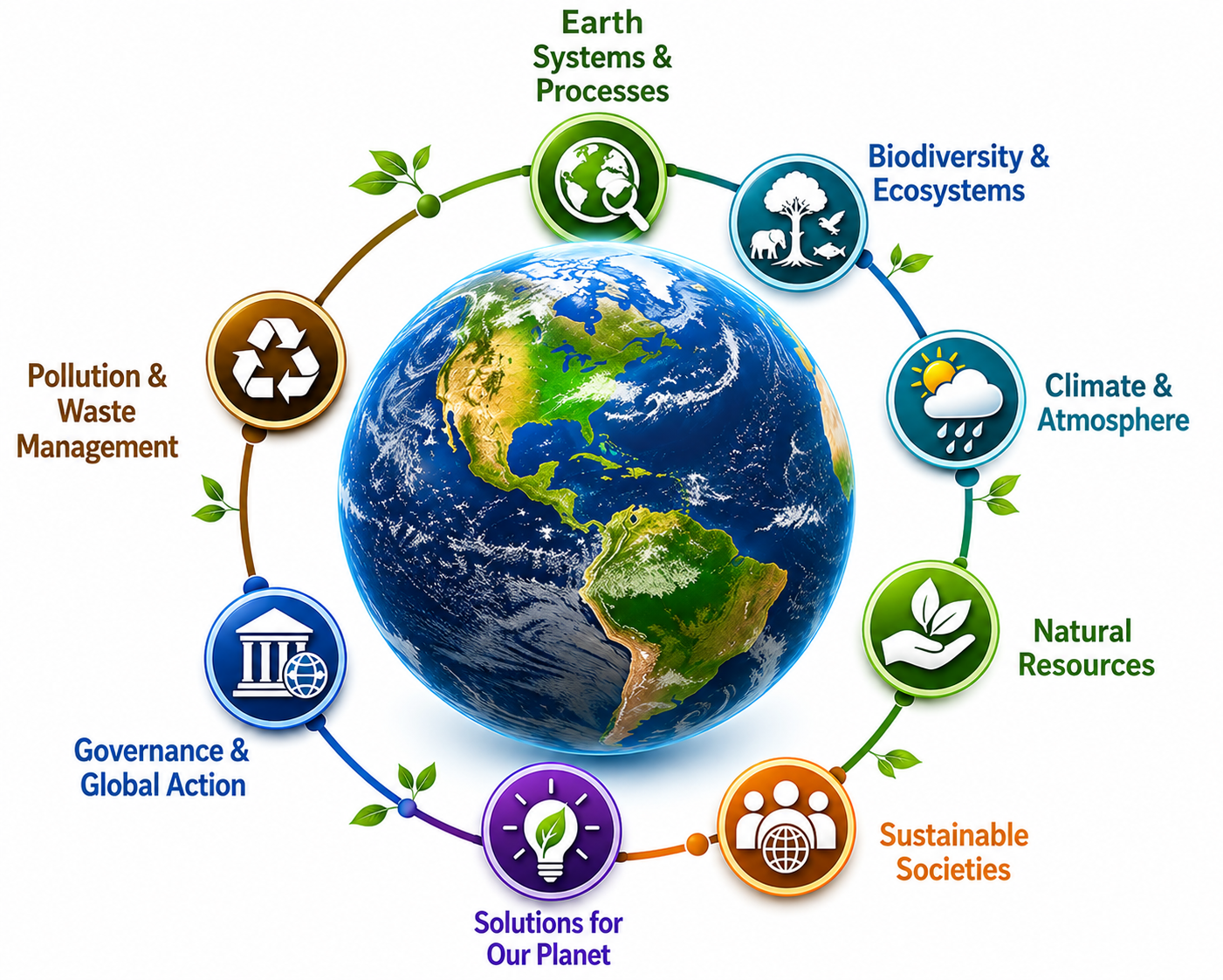
🌍 1. Earth Systems & Processes
Earth is not a collection of separate parts but a complex, interconnected system in which the atmosphere, hydrosphere, geosphere, biosphere and cryosphere continuously interact. The Earth receives energy from the Sun, circulates water and nutrients, exchanges carbon among land, oceans and atmosphere, and supports an extraordinary diversity of life. Processes such as the water cycle, carbon cycle, nutrient cycles, weathering, erosion, ocean circulation, atmospheric circulation and energy flows continually reshape the planet.
The Studentsfree Global Environmental Science Expert helps students understand these processes as dynamic and interconnected systems rather than isolated scientific facts. A change in one component can influence many others: changes in climate can affect water, biodiversity, agriculture and human settlements; land-use changes can influence carbon, water and ecosystems; and human activities can alter natural cycles on a planetary scale. Students therefore learn to ask not only “What is happening?” but also “Why is it happening, what is connected to it, and what may happen next?”
🧬 2. Biodiversity & Ecosystems
Biodiversity encompasses the extraordinary variety of life on Earth, including genes, species, populations and ecosystems. Forests, grasslands, wetlands, rivers, oceans, deserts and other ecosystems provide habitats for organisms and perform essential ecological functions. Through processes such as pollination, decomposition, nutrient cycling, soil formation, carbon storage and food-web interactions, ecosystems help maintain the conditions upon which both nature and human societies depend.
The Expert encourages students to understand biodiversity not simply as a list of plants and animals, but as a living network of relationships. It examines biodiversity loss, habitat destruction, invasive species, overexploitation, pollution and climate change while also exploring conservation, restoration and sustainable use. Students learn why protecting biodiversity is connected to food security, water, health, livelihoods, culture and planetary resilience—and why conserving one species or ecosystem can sometimes have consequences far beyond that particular place.
🌡️ 3. Climate & Atmosphere
The atmosphere is a dynamic envelope surrounding Earth that regulates temperature, distributes heat and moisture, supports life and drives weather and climate processes. Students explore atmospheric composition, radiation, greenhouse gases, atmospheric circulation, clouds, precipitation, weather patterns and the relationship between weather and long-term climate. They also examine how oceans, land surfaces, ice and living organisms interact with the atmosphere to create the Earth's climate system.
Climate change is therefore approached as more than simply “global warming.” Students investigate the evidence for changing temperatures, precipitation, extreme events, sea levels, oceans and cryosphere systems, while examining the human activities that influence greenhouse-gas concentrations. The Expert also distinguishes climate science, climate impacts, adaptation and mitigation, helping learners evaluate evidence critically and understand both the risks and the range of responsible responses available to societies.
🌿 4. Natural Resources
Human civilization depends upon Earth's natural resources, including water, forests, soil, minerals, fossil fuels, renewable energy, fisheries and biological resources. These resources provide food, energy, materials, shelter and economic opportunities. Understanding them requires examining not only their availability but also their distribution, renewal rates, extraction, consumption, environmental impacts and importance to different communities and economies.
The Expert encourages students to think beyond the question “How much resource do we have?” and consider “How are we using it, who depends upon it, what are the consequences, and can it remain available for future generations?” Students explore resource conservation, efficiency, renewable alternatives, sustainable management, resource security and equitable access. The Indian context is connected with global resource challenges so that learners can understand how local water, forest, soil and energy decisions can be part of much larger planetary systems.
🧑🤝🧑 5. Sustainable Societies
Human beings are both part of nature and powerful agents of environmental change. Communities, cities, economies, industries, transportation systems, agriculture and patterns of consumption all depend upon environmental resources and influence ecological conditions. Sustainable societies seek ways to meet human needs while maintaining the ecological systems and resources upon which present and future generations depend.
The Expert explores sustainable cities, responsible consumption, environmental justice, livelihoods, population dynamics, technology, energy, food systems and community participation. Rather than presenting sustainability as a single formula, it encourages students to examine trade-offs, inequalities and different local circumstances. A sustainable solution for one community may not automatically work elsewhere. Students therefore learn to connect environmental protection with social wellbeing, economic opportunity, cultural values and intergenerational responsibility.
♻️ 6. Pollution & Waste Management
Pollution occurs when harmful substances, energy or other agents enter the environment at levels that can damage ecosystems, organisms or human health. Students explore air, water, soil, marine, noise, chemical, plastic and other forms of pollution, together with their sources, pathways, impacts and control strategies. Waste is examined across its entire life cycle—from resource extraction and production to consumption, disposal and recovery.
The Expert moves beyond the traditional idea of simply “disposing of waste.” Students learn about waste prevention, reduction, reuse, recycling, composting, resource recovery, cleaner production and circular economy principles. They are encouraged to ask whether pollution can be prevented at its source rather than managed after damage has occurred. This approach connects individual behaviour with industrial systems, technology, public policy and resource management, helping learners understand that effective environmental protection requires prevention, responsibility and systemic change.
🏛️ 7. Governance & Global Action
Environmental challenges often cross political boundaries. Rivers flow between countries, air pollution travels across regions, wildlife migrates across borders, oceans connect nations, and climate change affects the entire planet. Environmental governance therefore involves laws, policies, institutions, scientific evidence, public participation, international agreements and cooperation at local, national and global levels.
The Expert helps students understand how environmental decisions are made, implemented and evaluated. They explore environmental legislation, regulatory institutions, environmental rights, justice, international treaties, global environmental organizations and the responsibilities of governments, businesses, communities and individuals. The goal is not merely to memorize environmental laws or agreements, but to understand the larger chain:
Science → Policy → Law → Institutions → Implementation → Participation → Accountability → Justice
This enables students to think critically about how societies can transform environmental knowledge into responsible collective action.
💡 8. Solutions for Our Planet
Environmental science should not end with identifying problems. It must also explore credible pathways toward solutions. Students encounter conservation, ecosystem restoration, renewable energy, energy efficiency, sustainable agriculture, circular economy approaches, green technologies, climate adaptation, decarbonization, nature-based solutions and innovative approaches to environmental management. Scientific evidence is used to examine both the potential and limitations of different solutions.
The Expert encourages learners to become solution-oriented but evidence-conscious. A proposed solution should be examined by asking: Does it work? At what scale? For whom? At what environmental and economic cost? What unintended consequences might occur? Is it equitable? Can it be sustained over time? Through this approach, students learn that there is rarely one universal answer to an environmental challenge. The most responsible solutions often combine science, technology, ecological knowledge, local experience, ethical reasoning, good governance and community participation.