From Ancient Wisdom to the Future of Global Economics
The Long Journey of Economic Thought
Economics is not only the study of markets, money and modern business. It is a long human story about how societies produce, distribute and use resources, organize work, exchange goods and respond to scarcity. Long before economics became a formal academic discipline, civilizations developed sophisticated ideas about taxation, agriculture, trade, wealth, public finance, labour and economic administration. Exploring this history helps us understand that many contemporary economic questions have deep historical roots.
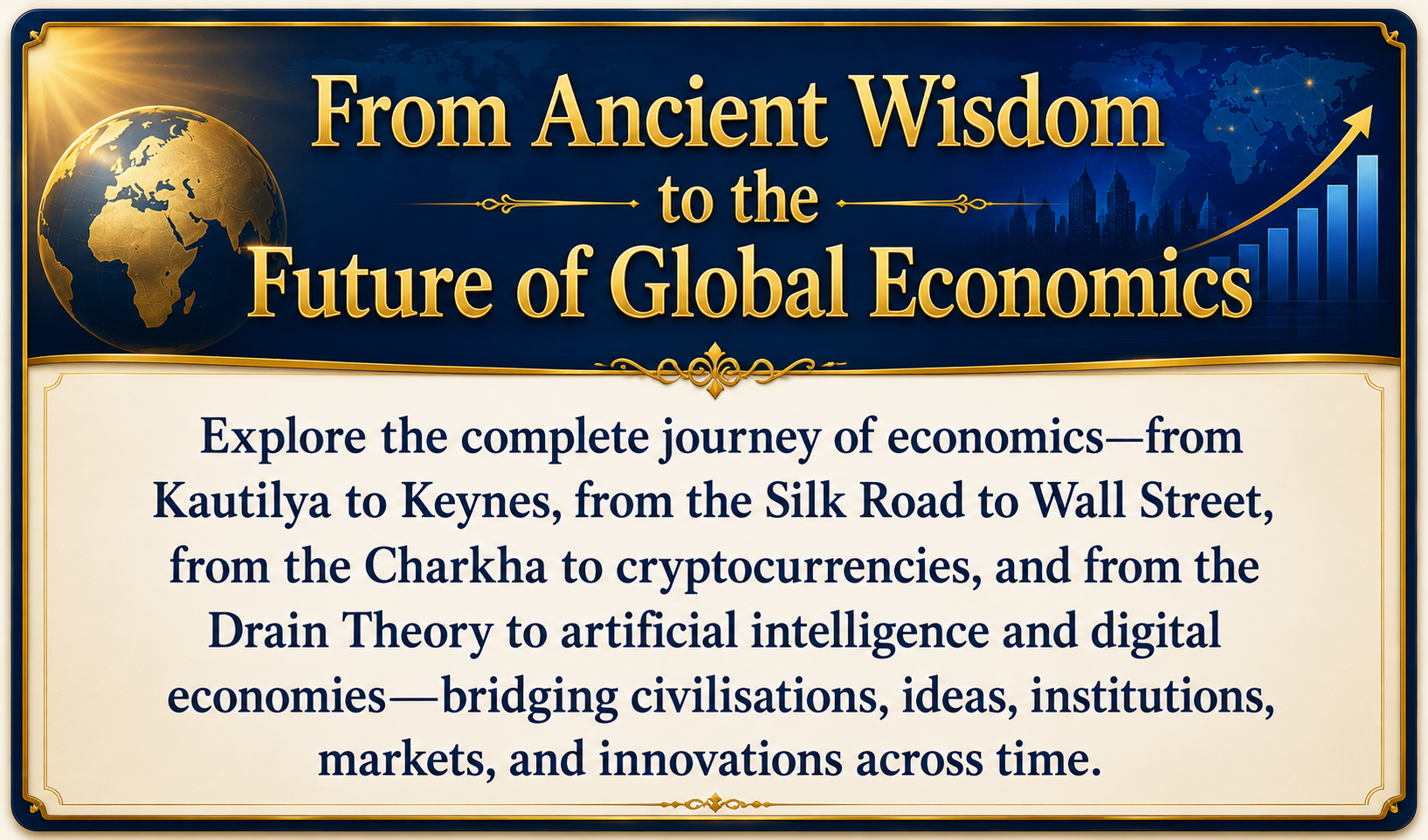
The journey represented in the image—from Kautilya to Keynes, from the Silk Road to Wall Street, from the Charkha to cryptocurrencies, and from Drain Theory to artificial intelligence—connects economic ideas and institutions across very different periods. It demonstrates how economic systems evolve in response to technological change, political power, social needs, international exchange and human innovation.
Kautilya and the Foundations of Economic Thought
Ancient Indian traditions contain important discussions of governance, taxation, agriculture, trade, public finance and statecraft. Kautilya's Arthashastra is particularly significant for the study of ancient Indian political economy. Its discussions of taxation, revenue, markets, production, trade, regulation and administration provide valuable evidence of sophisticated thinking about economic organization in the ancient world.
Studying Kautilya does not mean treating ancient economic thought as identical to modern economics. The concepts and institutions belonged to a different historical context. Rather, they provide an opportunity to investigate how earlier societies understood wealth, resources, administration and the responsibilities of the state.
The Silk Road and the Expansion of Economic Connections
The Silk Road represents one of history's great networks of economic and cultural exchange. It connected communities across Asia, the Middle East, Europe and other regions through the movement of commodities, people, technologies, religions and ideas. Silk was only one part of a much broader system of exchange.
The history of such networks demonstrates that globalization is not entirely a modern phenomenon. Long-distance trade created connections between distant societies and contributed to the circulation of goods, knowledge and cultural practices. Studying these networks helps learners understand the historical foundations of international commerce and economic interdependence.
From Industrial Transformation to Modern Economics
The Industrial Revolution fundamentally transformed economic life. Mechanized production, factories, urbanization, expanding markets, new forms of labour and technological innovation changed the relationship between production and society. These transformations generated new economic opportunities while also producing serious questions about working conditions, inequality, wages and the distribution of wealth.
The development of modern economic thought was closely connected with these transformations. Classical economists examined production, labour, markets and wealth, while later thinkers developed new approaches to economic crises, employment, development and government intervention.
Keynes and the Modern Macroeconomic Perspective
The work of John Maynard Keynes became particularly influential in the context of the economic instability of the twentieth century. Keynesian economics emphasized aggregate demand, employment and the role that government policy can play in responding to economic downturns.
The importance of Keynes extends beyond one particular theory. His work illustrates how economic thought can respond to major historical circumstances. Economic theories develop, change and sometimes compete with one another as economists attempt to explain changing economic realities.
The Charkha, Colonialism and Drain Theory
The Charkha can be understood within the wider history of Indian economic nationalism and debates over colonial economic transformation. It became associated with self-reliance, indigenous production and resistance to dependence on imported manufactured goods.
Drain Theory, associated particularly with Dadabhai Naoroji, provided an important critique of colonial economic structures. It argued that significant resources were being transferred from India to Britain through various mechanisms of colonial rule. Studying these ideas connects economics with history, politics and the development of Indian nationalism.
From Wall Street to Global Financial Systems
The reference to Wall Street represents the emergence of modern financial capitalism and the increasing importance of financial markets in the global economy. Stock exchanges, banks, investment institutions, corporations and international capital flows have become central components of modern economic life.
At the same time, financial history demonstrates that markets can experience instability and crises. Understanding financial systems therefore requires attention not only to investment and growth, but also to regulation, risk, inequality, institutions and the historical circumstances surrounding major economic crises.
Cryptocurrencies and the Digital Transformation
The emergence of cryptocurrencies represents another major stage in the history of money and economic exchange. Digital assets have introduced new questions concerning money, decentralization, financial technology, regulation, ownership and digital markets.
Cryptocurrencies also demonstrate how technological innovation can challenge established economic institutions. Their development raises important questions about what constitutes money, how trust is created in financial systems, how transactions should be regulated and how technological change may reshape future economic relationships.
Artificial Intelligence and the Future of Economics
Artificial Intelligence is now influencing production, employment, financial services, markets, business decision-making and the organization of knowledge. AI can increase productivity and create new economic opportunities, while simultaneously raising questions about employment displacement, skills, inequality, intellectual property, market concentration and the distribution of economic gains.
The future of economics will therefore involve not only traditional questions of supply, demand and markets, but also questions about data, automation, algorithms, digital platforms and human-machine collaboration. Understanding these developments requires both economic theory and historical perspective.
Connecting Civilizations, Ideas, Institutions and Innovation
The central message of this journey is that economics has never existed separately from human civilization. Ideas influence institutions; institutions influence markets; markets influence societies; and technological innovations transform all of them. Economic history allows us to trace these relationships across centuries.
From ancient systems of administration to global trade networks, from industrialization to modern financial markets, and from the Charkha to artificial intelligence, economic life reflects humanity's continuing attempt to solve problems of resources, production, exchange, distribution and well-being.
Looking Toward the Future
The future of global economics will be shaped by technological innovation, demographic change, environmental challenges, international cooperation, changing patterns of trade and finance, and new forms of digital economic activity. Understanding the future requires more than predicting economic indicators; it requires understanding the historical forces that brought the world to its present condition.
From ancient wisdom to artificial intelligence, the study of economics is ultimately the study of how human societies create, exchange, organize and transform resources and opportunities. Exploring that journey enables learners to connect the past with the present and to think more critically about the economic possibilities and challenges of the future.