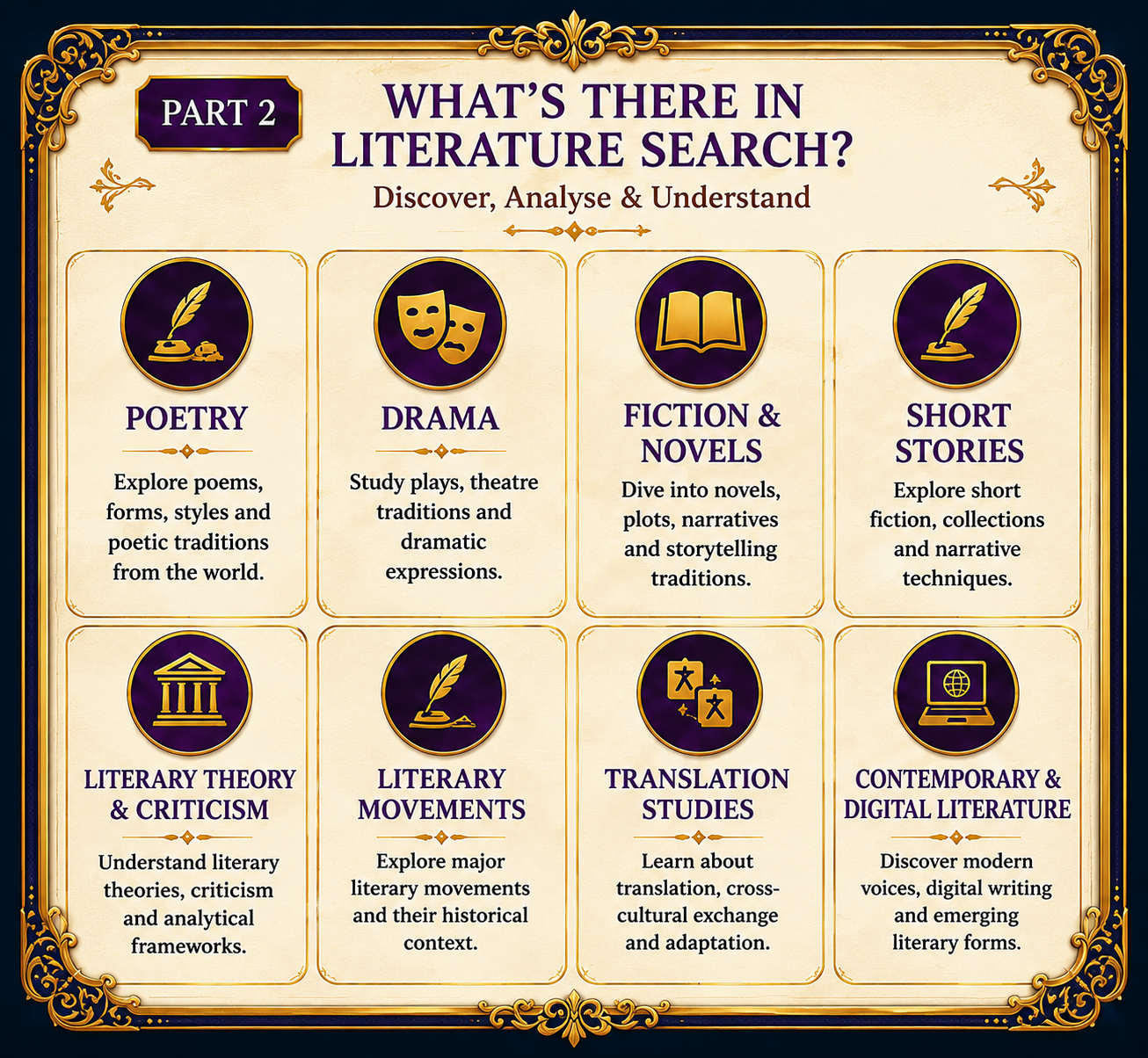
1. POETRY
Explore poems, forms, styles, voices and poetic traditions from around the world.
Poetry is one of humanity's oldest literary forms. Through rhythm, imagery, metaphor, symbolism and carefully chosen language, poets express emotions, ideas, experiences and visions of the world.
Explore Poetry
1. Major Poetic Forms
- Epic poetry
- Lyric poetry
- Narrative poetry
- Dramatic poetry
- Elegy
- Ode
- Sonnet
- Ballad
- Haiku
- Ghazal
- Free verse
2. Elements of Poetry
- Rhythm
- Meter
- Rhyme
- Stanza
- Imagery
- Metaphor
- Simile
- Symbolism
- Alliteration
- Personification
3. World Poetic Traditions
- Sanskrit poetry
- Tamil poetry
- Arabic poetry
- Persian poetry
- Chinese poetry
- Japanese poetry
- European poetry
- African oral poetry
4. Major Poets & Traditions
- Homer
- Dante
- Shakespeare
- Wordsworth
- Keats
- Emily Dickinson
- Rabindranath Tagore
- Pablo Neruda
- Contemporary poets
Explore Further
Poets • Poems • Forms • Literary Devices • Movements • Themes • Translations • Poetic Analysis • Questions
Studentsfree Literature Search:
Discover how humanity has transformed language into rhythm, emotion, imagination and meaning.
2. DRAMA
Study plays, theatre traditions, dramatic structures and performances from different cultures and historical periods.
Drama brings literature to life through dialogue, character, conflict, action and performance.
Explore Drama
1. Origins of Drama
- Greek theatre
- Sanskrit drama
- Roman theatre
- Medieval drama
- Traditional Asian theatre
2. Dramatic Forms
- Tragedy
- Comedy
- Tragicomedy
- Historical drama
- One-act play
- Absurdist drama
- Musical theatre
3. Elements of Drama
- Plot
- Character
- Dialogue
- Setting
- Conflict
- Theme
- Stage directions
4. Major Dramatic Traditions
- Greek tragedy
- Shakespearean theatre
- Sanskrit drama
- Japanese Noh
- Kabuki
- Chinese opera
- African theatre
- Modern theatre
5. Major Playwrights
- Sophocles
- Shakespeare
- Kalidasa
- Molière
- Henrik Ibsen
- Anton Chekhov
- George Bernard Shaw
- Bertolt Brecht
- Arthur Miller
Explore Further
Plays • Playwrights • Theatre • Dramatic Forms • Characters • Themes • Performance • Theatre History • Analysis
Studentsfree Literature Search:
Explore the stage where stories become action, conflict, character and performance.
3. FICTION & NOVELS
Dive into novels, plots, narratives, characters and storytelling traditions across cultures and centuries.
Fiction creates imagined worlds through narrative, character, setting and language. The novel has become one of the most influential literary forms of the modern era.
Explore Fiction & Novels
1. Major Fiction Forms
- Novel
- Novella
- Short novel
- Historical fiction
- Science fiction
- Fantasy
- Detective fiction
- Psychological fiction
2. Elements of Fiction
- Plot
- Character
- Setting
- Narrator
- Point of view
- Theme
- Symbolism
- Style
3. Narrative Techniques
- First-person narration
- Third-person narration
- Stream of consciousness
- Flashback
- Foreshadowing
- Unreliable narrator
- Multiple perspectives
4. Global Novel Traditions
- European novel
- Indian novel
- African novel
- Latin American novel
- Asian novel
- Middle Eastern fiction
5. Major Literary Movements
- Romantic fiction
- Realism
- Naturalism
- Modernism
- Postmodernism
- Postcolonial fiction
Explore Further
Novels • Authors • Characters • Plot • Themes • Genres • Narrative Techniques • Literary Analysis • Adaptations
Studentsfree Literature Search:
Enter imagined worlds and discover how writers use stories to explore human experience.
4. SHORT STORIES
Explore short fiction, collections, narrative techniques and the art of storytelling in a compact literary form.
The short story can create an entire world within a limited space. Its power often lies in concentration, suggestion, character, atmosphere and carefully structured narrative.
Explore Short Stories
1. Forms
- Traditional short story
- Modern short story
- Flash fiction
- Frame narrative
- Anecdotal fiction
2. Elements
- Plot
- Character
- Setting
- Conflict
- Point of view
- Theme
- Atmosphere
3. Storytelling Techniques
- Beginning in medias res
- Foreshadowing
- Symbolism
- Irony
- Open endings
- Multiple perspectives
4. Global Traditions
- Indian short stories
- European short stories
- American short stories
- African short stories
- Latin American short stories
- Asian short stories
5. Important Writers
- Anton Chekhov
- Edgar Allan Poe
- Guy de Maupassant
- Rabindranath Tagore
- Katherine Mansfield
- Jorge Luis Borges
- Saadat Hasan Manto
Explore Further
Stories • Authors • Collections • Narrative Techniques • Themes • Literary Analysis • Translations • Questions
Studentsfree Literature Search:
Discover how great writers create powerful worlds within the limits of a short narrative.
5. LITERARY THEORY & CRITICISM
Understand literary theories, critical approaches and analytical methods used to interpret literature.
Literary criticism asks important questions about texts: How does a work create meaning? Whose voice does it represent? What assumptions does it contain? How does society influence literature?
Explore Literary Theory & Criticism
1. Classical Criticism
- Plato
- Aristotle
- Poetics
- Classical aesthetics
- Mimesis
- Catharsis
2. Major Critical Approaches
- Formalism
- Structuralism
- Poststructuralism
- Marxist criticism
- Psychoanalytic criticism
- Feminist criticism
- Reader-response criticism
- Postcolonial criticism
- New Historicism
- Ecocriticism
3. Key Concepts
- Text
- Author
- Reader
- Meaning
- Discourse
- Ideology
- Power
- Representation
- Identity
4. Literary Analysis
- Close reading
- Character analysis
- Narrative analysis
- Theme analysis
- Symbolic analysis
- Contextual interpretation
Explore Further
Theories • Critics • Schools • Concepts • Critical Essays • Literary Terms • Textual Analysis • Research Methods
Studentsfree Literature Search:
Learn not only what literature says, but how different critical approaches reveal its deeper meanings.
6. LITERARY MOVEMENTS
Explore major literary movements and understand the historical, cultural and intellectual contexts in which they emerged.
Literary movements represent changing ways of writing, thinking, imagining and responding to society.
Explore Literary Movements
1. Classical Traditions
- Classicism
- Neoclassicism
2. Romanticism
- Imagination
- Nature
- Emotion
- Individualism
3. Realism & Naturalism
- Everyday life
- Society
- Social conditions
- Determinism
4. Modernism
- Fragmentation
- Experimentation
- Urban experience
- Stream of consciousness
5. Postmodernism
- Intertextuality
- Irony
- Fragmentation
- Metafiction
6. Postcolonial Literature
- Colonialism
- Identity
- Resistance
- Cultural hybridity
- Language
7. Other Important Movements
- Symbolism
- Surrealism
- Existentialism
- Absurdism
- Harlem Renaissance
- Magical Realism
- Feminist literature
Explore Further
Movements • Periods • Authors • Works • Historical Context • Ideas • Characteristics • Comparative Study
Studentsfree Literature Search:
Understand how literature changes when societies, ideas and human perspectives change.
7. TRANSLATION STUDIES
Learn how literature crosses languages and cultures through translation, adaptation, interpretation and cultural exchange.
Translation allows literary works to travel beyond their original linguistic communities and become part of wider world literature.
Explore Translation Studies
1. Foundations
- Meaning of translation
- Literary translation
- Translation theory
- Source and target texts
2. Translation Methods
- Literal translation
- Free translation
- Adaptation
- Localization
- Cultural translation
3. Translation & Culture
- Cultural context
- Idioms
- Symbols
- Religion
- Cultural identity
- Linguistic differences
4. Literature in Translation
- Indian literature
- Asian literature
- African literature
- European literature
- Latin American literature
5. Translation & World Literature
- Literary circulation
- Global readership
- Reception
- Cultural exchange
- Canon formation
Explore Further
Translators • Translated Works • Translation Theory • Languages • Adaptation • Comparative Literature • Reception
Studentsfree Literature Search:
Follow literature as it travels from one language and culture into another.
8. CONTEMPORARY & DIGITAL LITERATURE
Discover modern literary voices, digital writing, experimental forms and emerging ways of creating and experiencing literature.
Literature continues to evolve with changing societies and technologies. Digital environments have created new forms of storytelling while contemporary writers continue to experiment with language, structure and media.
Explore Contemporary & Digital Literature
1. Contemporary Literature
- 21st-century writing
- Global fiction
- Contemporary poetry
- Contemporary drama
- New literary voices
2. Digital Literature
- Electronic literature
- Hypertext fiction
- Interactive narratives
- Digital poetry
- Web-based storytelling
3. New Storytelling Forms
- Multimedia narratives
- Interactive fiction
- Serialized digital fiction
- Social-media storytelling
- Visual narratives
4. Emerging Themes
- Technology
- Climate change
- Migration
- Identity
- Globalization
- Artificial intelligence
- Digital culture
5. Literature & New Media
- Literature and film
- Literature and games
- Literature and visual culture
- Digital archives
- Online literary communities
Explore Further
Contemporary Authors • Digital Texts • E-Literature • Experimental Writing • New Media • AI & Literature • Emerging Genres