EXPLORE THE WORLD OF POLITICAL SCIENCE
Political Science is the systematic study of power, government, political institutions, public policy, political ideas, rights, international relations and the ways societies organize collective life. Studentsfree Political Science Search can help learners move from basic concepts to deeper questions about how governments function, how political systems differ, how policies are created, and how political ideas influence societies.
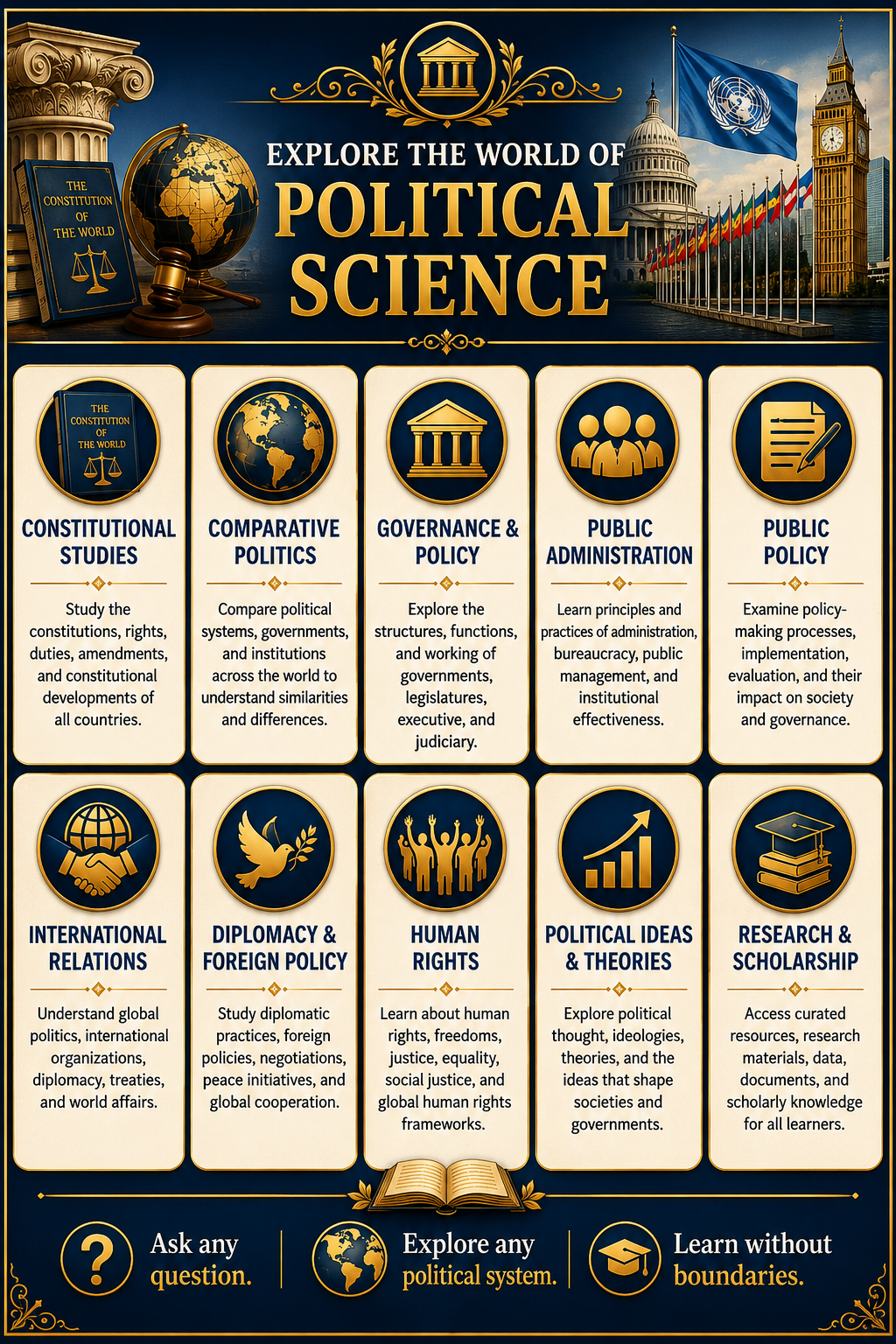
The ten areas displayed in the image provide a broad map of Political Science: Constitutional Studies, Comparative Politics, Governance & Policy, Public Administration, Public Policy, International Relations, Diplomacy & Foreign Policy, Human Rights, Political Ideas & Theories, and Research & Scholarship. Together, they create an entry point for students to explore political systems at the local, national and global levels.
1. CONSTITUTIONAL STUDIES
Constitutional Studies explores the foundations through which political authority is organized and limited. Students can search for constitutions, fundamental rights, duties, institutions, separation of powers, constitutional amendments, judicial review, federalism, citizenship and constitutional developments across different countries.
The search can also encourage comparison between constitutional systems. Students may explore how different constitutions distribute power between legislatures, executives and judiciaries, how rights are protected, and how constitutional principles evolve through amendments, court decisions and political practice.
2. COMPARATIVE POLITICS
Comparative Politics examines political systems by placing them alongside one another. Students can compare democracies, monarchies, authoritarian systems, federal and unitary governments, electoral systems, political parties, institutions and political cultures.
The purpose is not simply to identify similarities and differences, but to ask why political systems develop differently. Studentsfree Political Science Search can help learners investigate institutions, historical circumstances, economic conditions, political participation and social structures that influence political outcomes.
3. GOVERNANCE & POLITICS
Governance & Politics explores how political institutions actually exercise authority and how decisions are made within governments and political systems. Students can investigate legislatures, executives, judiciaries, political parties, elections, institutions, leadership, representation and political participation.
This area also opens questions about the relationship between citizens and the state. Learners can explore how governments gain legitimacy, how political power is distributed, how institutions interact, and how political processes influence public life.
4. PUBLIC ADMINISTRATION
Public Administration examines how government decisions are converted into programmes, services and administrative action. Students can explore bureaucracy, civil services, public organizations, administrative structures, leadership, accountability, public management and institutional effectiveness.
It also helps explain the practical side of government. A policy may be adopted politically, but its success often depends upon administration, resources, implementation, coordination and accountability. Political Science Search can therefore help learners understand the relationship between political decisions and administrative practice.
5. PUBLIC POLICY
Public Policy examines how governments identify problems, formulate responses, implement programmes and evaluate their results. Students can search areas such as education, health, environment, economy, social welfare, employment, technology, taxation and development policy.
A deeper search can follow a policy through its entire cycle: problem identification → agenda setting → formulation → decision-making → implementation → evaluation → revision. This allows students to understand not only what a government policy says, but also why it was introduced and what effects it may have.
6. INTERNATIONAL RELATIONS
International Relations examines political relationships beyond national borders. Students can explore states, international organizations, alliances, conflicts, cooperation, treaties, global institutions, international law and world affairs.
Searches can also investigate major global issues such as war and peace, security, globalization, international cooperation, migration, climate politics, economic relations and changing global power structures. This helps learners understand how events in one part of the world can influence political and economic developments elsewhere.
7. DIPLOMACY & FOREIGN POLICY
Diplomacy & Foreign Policy focuses on how states interact with one another and pursue their interests internationally. Students can explore diplomatic relations, negotiations, treaties, foreign-policy doctrines, peace initiatives, strategic partnerships and international cooperation.
The AI Expert can also help learners examine how countries respond to changing international circumstances. Historical events, geography, security concerns, economic interests, domestic politics and leadership can all influence foreign-policy choices. This makes diplomacy an excellent field for comparative and analytical exploration.
8. HUMAN RIGHTS
Human Rights examines the principles and institutions concerned with human dignity, freedom, equality, justice and protection from discrimination and abuse. Students can explore civil and political rights, economic and social rights, women's rights, children's rights, minority rights, refugee rights and other dimensions of human rights.
Students can also investigate how rights are protected through constitutions, legislation, courts, national institutions and international frameworks. The subject naturally connects Political Science with law, history, international relations, sociology and ethics, making it an important interdisciplinary field.
9. POLITICAL IDEAS & THEORIES
Political Ideas & Theories explores the concepts and intellectual traditions that have shaped political thought. Students can search concepts such as liberty, equality, justice, democracy, sovereignty, power, citizenship, rights, authority and the state.
They can also explore major political thinkers and traditions, from classical political philosophy to modern and contemporary theories. Comparing different thinkers can help students understand why political questions rarely have only one answer and how competing ideas continue to influence governments, institutions and societies.
10. RESEARCH & SCHOLARSHIP
Research & Scholarship provides the academic foundation for studying Political Science systematically. Students can explore research questions, political concepts, theories, methods, data, case studies, comparative research, surveys, interviews, documents and scholarly literature.
This section can be especially valuable for undergraduate and postgraduate students preparing assignments, seminars, projects, dissertations, theses and examinations. The Political Science AI Expert can help learners identify concepts, organize questions and explore research directions, while important academic claims should always be verified against authoritative books, journals, official documents and other reliable sources.